Health Risk Assessments (HRAs) are one of the most valuable tools health plans and employers have for understanding a population's health risks early — and one of the most underused. The data an HRA collects feeds directly into personalized care plans, risk stratification, and outreach targeting. The problem isn't the tool. It's completion.
Most HRA programs still rely on a static form: a PDF, a portal link, or a paper mailer rather than a digital HRA members can complete on their phone. These formats assume the member will find time to sit down, log in, and fill it out unprompted. That assumption is where most HRA programs fail. Low completion rates mean health plans and employers are making coverage and care decisions on incomplete data — and the members most likely to skip the assessment are often the ones with the most to gain from being flagged early.
Why HRA Completion Rates Are So Low
The barriers are consistent across the industry: HRAs are long, they're not mobile-first, they arrive at the wrong moment (buried in an open enrollment packet, disconnected from any immediate benefit to the member), and there's no real-time support if a member gets stuck or has a question mid-form. A static form also can't adapt — every respondent sees every question, whether or not it's relevant to them, which makes the experience feel longer and more impersonal than it needs to be.
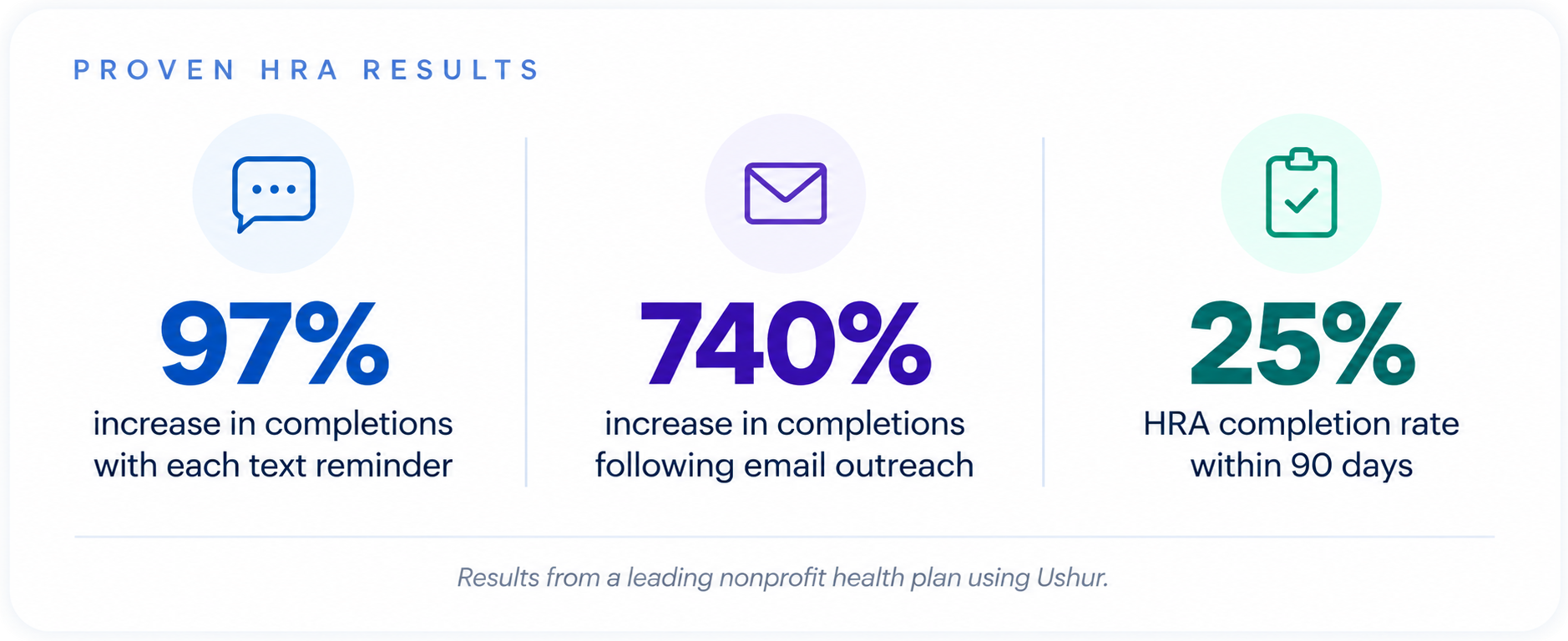
The impact of a more proactive, digital approach can be significant. A leading nonprofit health plan with more than 2 million members used Ushur to engage Medicare members in completing their HRAs through SMS, email, and the Invisible App, a user-friendly and HIPAA-compliant digital channel for information exchange and two-way communication. The health plan saw a 97% jump in HRA completions with each text reminder and a 740% increase following email outreach, while achieving a 25% completion rate within the required 90-day window. Completed HRA data was then integrated into its care management platform to help identify care gaps, prioritize higher-risk members, and support preventive care outreach.
Ushur Smooths the Way
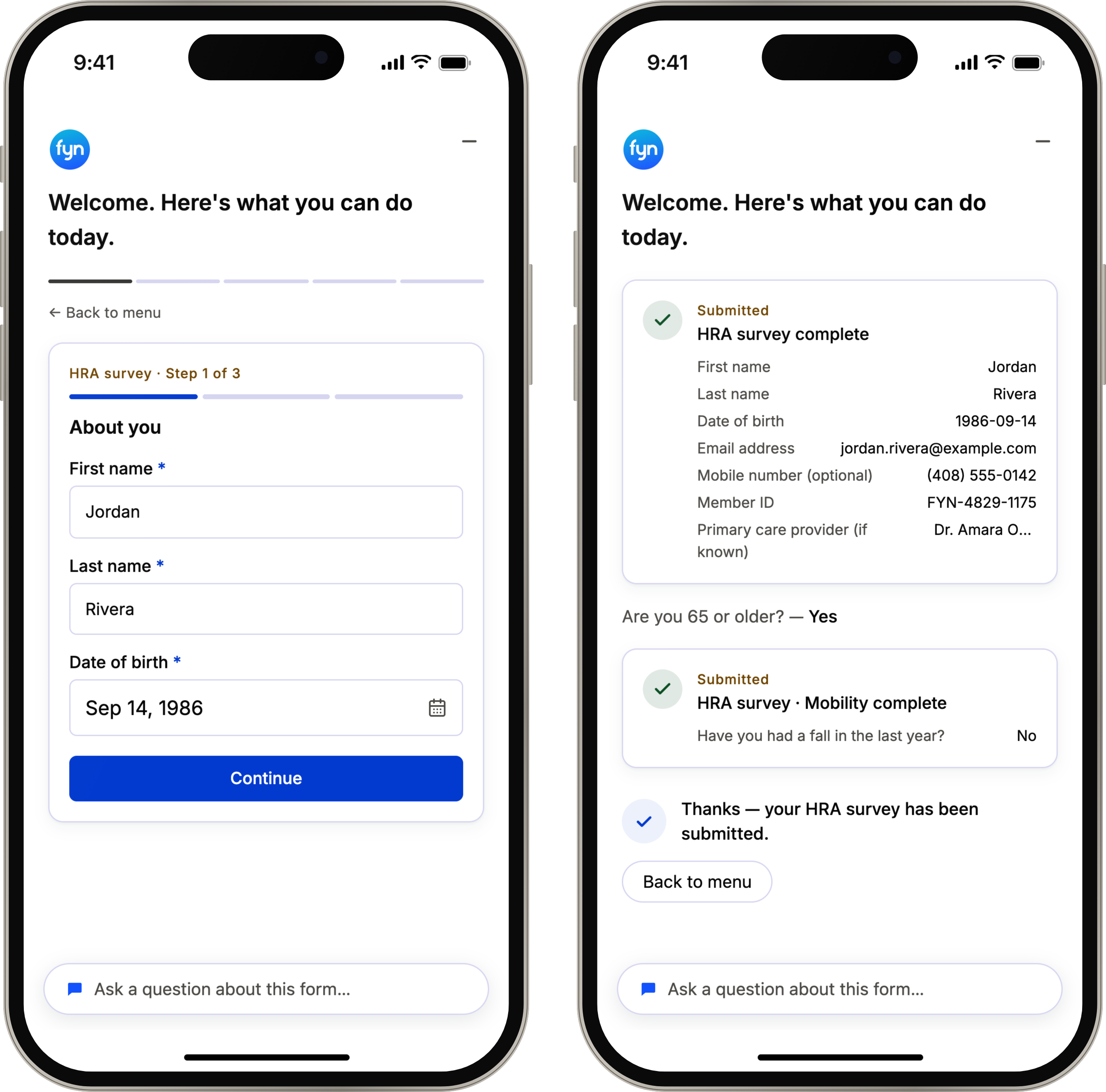
Ushur's Invisible App turns the HRA from a static form into a guided, conversational experience that meets members on the channel they already use — SMS, email, or chat — instead of requiring a portal login. That shift addresses most of the friction points above:
- Adaptive, not one-size-fits-all. Ushur skips irrelevant questions and probes deeper on answers that matter, the way a good care coordinator would in a live conversation — instead of presenting every member with an identical, static question list.
- Available in the moment, not just at enrollment. Because outreach is agentic and can be triggered by real events (a new enrollment, a missed refill, a life event), HRAs stop being tied exclusively to the open enrollment calendar and become part of ongoing member engagement.
- Immediate, contextual help. If a member has a question or hits a barrier mid-assessment, Ushur can respond in the moment, in the member's preferred language, rather than routing them to a call center queue.
- Directly tied to next steps. Completed HRA data flows straight into personalized care plan creation and risk stratification — closing the loop between collecting the data and acting on it, which is where many legacy HRA programs stop short.
Built for Sensitive Health Data, By Design
HRAs collect some of the most sensitive data a health plan or employer will ever ask for — biometric information, medical history, mental health indicators. That makes the underlying platform's compliance posture non-negotiable. Health Risk Assessments run on Ushur's Trust-Native architecture: HIPAA-compliant, PHI-protected, with end-to-end encryption and no requirement for members to download an app or manage a separate login. For employers extending HRAs into wellness programs, that same Trust-Native foundation applies whether the data is flowing to a health plan, a third-party administrator, or an internal HR system.
From Data to Action: Personalized Care Plans
An HRA is only as valuable as what happens after it's submitted. Ushur connects the assessment directly to downstream workflows — routing high-risk responses to care management outreach, triggering targeted educational content, or feeding structured data into a health plan's existing risk models — so completion doesn't dead-end in a database. The goal isn't just a higher completion rate; it's a faster, more complete picture of population health that a health plan or employer can actually act on.
Conclusion
Low HRA completion isn't a member-engagement problem you solve with more reminders — it's a format problem. A static, one-size-fits-all form asks members to do the platform's job for it. Ushur's Invisible App, powered by AI agents that adapt to the individual, shows up on the right channel at the right moment, and closes the loop from data to action — turning the HRA from a compliance checkbox into a genuinely useful early-warning system for population health.
Ready to see how Ushur can improve your HRA completion rates? Learn more at ushur.ai/request-demo.
Frequently Asked Questions
What is a Health Risk Assessment (HRA)?
An HRA is a structured questionnaire — used by health plans and employers — that captures a person's health history, risk factors, and behaviors to inform personalized care planning and risk stratification.
Why are HRA completion rates so low?
Static, portal-based HRA forms are long, arrive at the wrong moment (often buried in open enrollment materials), and offer no real-time help — all of which depress completion compared to a guided, conversational format.
How does Ushur improve HRA completion rates?
Ushur delivers HRAs conversationally over SMS, email, or chat through its Invisible App, adapts questions to the respondent in real time, and answers questions immediately — replacing the static-form experience that drives most HRA abandonment. One nonprofit health plan saw a 97% jump in HRA completions with each text reminder and a 740% increase following email outreach.
Is HRA outreach HIPAA-compliant on Ushur?
Yes. Health Risk Assessments run on Ushur's Trust-Native architecture, built for HIPAA compliance and PHI protection, with end-to-end encryption and no separate login or app download required.