Insurance customers expect fast, digital-first service: the same speed and convenience they get from every other app on their phone. Conversational technology, starting with chatbots, has become one of the most visible ways insurers try to deliver that. But "chatbot" covers a wide range of capability, from a scripted FAQ widget to something that can actually complete a task. Here's what insurance chatbots do well, where they fall short, and why AI agents represent the next step beyond them.
What Is an Insurance Chatbot?
An insurance chatbot is a conversational tool, usually deployed on a website, app, or messaging channel, that lets customers ask questions and get answers without waiting for a live agent. Insurance chatbots typically fall into two categories:
- Rule-based chatbots follow predetermined decision trees. They're fast to deploy and fine for narrow, predictable questions ("What's my deductible?"), but they break down the moment a customer's question doesn't match a scripted path.
- AI-powered chatbots use natural language processing to understand a wider range of phrasing and intent, making them more flexible than rule-based bots, but most are still built to answer questions, not complete transactions.
5 Insurance Chatbot Benefits
- 24/7 availability. Customers can get answers outside business hours, without waiting for a call center to open.
- Reduced call center volume. Routine questions (policy details, coverage basics, payment due dates) get resolved without tying up a live agent, freeing staff for complex cases.
- Faster first response. Where a phone queue might mean a 10-minute hold, a chatbot responds instantly, which matters most during peak periods like claims season or open enrollment.
- Consistent answers. A well-configured chatbot gives the same accurate answer every time, reducing the variability that comes with agent training gaps.
- Lower cost per interaction. Automating routine, high-volume questions costs a fraction of a live-agent interaction, letting insurers reallocate budget toward the interactions that actually need a human.
3 Insurance Chatbot Use Cases
- Policy and coverage questions. "What does my policy cover?" or "When is my premium due?" are high-volume, low-complexity questions that don't need a human.
- First notice of loss (FNOL) intake. A customer can report a claim conversationally, at 2am, without waiting for business hours, capturing the basic facts of the loss immediately, when the details are freshest. See how Ushur handles FNOL.
- Renewal and payment reminders. Proactive, two-way reminders that let customers confirm, ask a question, or take action directly in the conversation, instead of receiving a one-way email they have to act on somewhere else. See how Ushur handles payments.
Chatbots vs. AI Agents: What's the Difference?
This is the part most "insurance chatbot" content skips, and it's the most important distinction for anyone evaluating these tools today.
A chatbot, even an AI-powered one, is built to answer a question and stop. It's a conversational front end to an FAQ. An AI agent is built to complete the underlying task: not just tell the customer what their deductible is, but actually process the payment; not just explain how to file a claim, but actually take the FNOL intake, route it to the right queue, and follow up automatically until it's resolved.
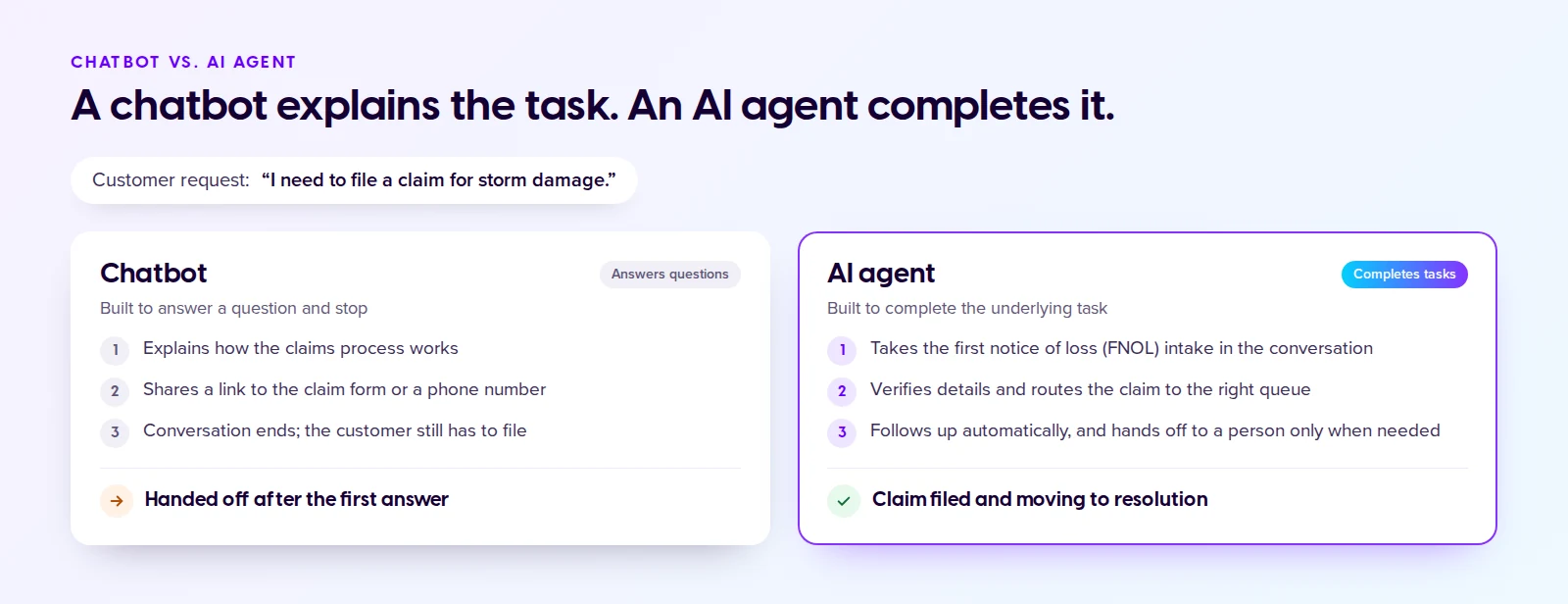
That distinction matters more in insurance than almost any other industry, because so much of what customers need isn't a question. It's a multi-step transaction: filing a claim, updating a beneficiary, resolving a billing discrepancy, completing a policy change. A chatbot can tell a customer how to do those things. An AI agent does them.
Ushur's AI agents are built specifically for this: they combine conversational understanding with the ability to reason across a multi-step workflow, take action in connected systems, and hand off to a human only when the situation genuinely needs one, all inside a Trust-Native architecture built for regulated industries like insurance, where PII and financial data are involved in nearly every interaction.
Can Chatbots Process Insurance Claims?
A rule-based chatbot generally can't. It can guide a customer to a form or a phone number, but it isn't built to actually execute the claim intake, verification, and routing steps. An AI agent can, because it's designed to complete the transaction end to end rather than hand it off after the first question is answered. This is the practical difference between a chatbot that talks about claims and an AI agent that processes them.
In practice, a Fortune 250 insurance carrier uses Ushur to collect key short-term disability claim dates over automated two-way text. 90% of claimants complete the request within an hour, replacing an average of six outbound calls and three weeks per claim (read the customer story).
Conclusion
Chatbots were the first step in moving insurance service online, and they're still useful for narrow, high-volume questions. But insurers evaluating conversational AI today should be asking a different question than "which chatbot": they should be asking whether the tool can actually finish the job a customer came to do. File the claim, not just explain how. Update the policy, not just describe the process. That's the gap AI agents close.
Ready to see how Ushur's AI agents go beyond a traditional insurance chatbot? Learn more at ushur.ai/request-demo.
Frequently Asked Questions About Insurance Chatbots and AI Agents
What is an insurance chatbot?
A conversational tool, either rule-based or AI-powered, that lets insurance customers ask questions and get answers without a live agent. It's typically limited to answering questions rather than completing transactions.
What's the difference between a chatbot and an AI agent?
A chatbot answers questions; an AI agent completes the underlying task, such as processing a claim or updating a policy, by reasoning across multiple steps and taking action in connected systems, not just providing information.
What are the benefits of AI-powered customer service in insurance?
24/7 availability, reduced call center volume, faster first response, consistent answers, and lower cost per interaction, with AI agents adding the ability to actually resolve transactions, not just answer questions about them.
Can chatbots process insurance claims?
Rule-based and most AI-powered chatbots can explain the claims process but can't execute it end to end. AI agents are built to actually process claims (intake, verification, and routing) as a completed transaction.