Executive Summary
- Leave administration has become a top employer priority: in Mercer's 2024 Absence and Disability Management Survey of 630 U.S. employers, 66% ranked improving leave administration among their top three priorities, up from 41% in 2021.
- The compliance risk is as real as the operational one: 68% of employers rank compliance with state and local leave mandates as a top-three priority, and 72% have had to add resources to keep up, while 14 states and the District of Columbia now have mandatory paid family leave programs, each with its own rules.
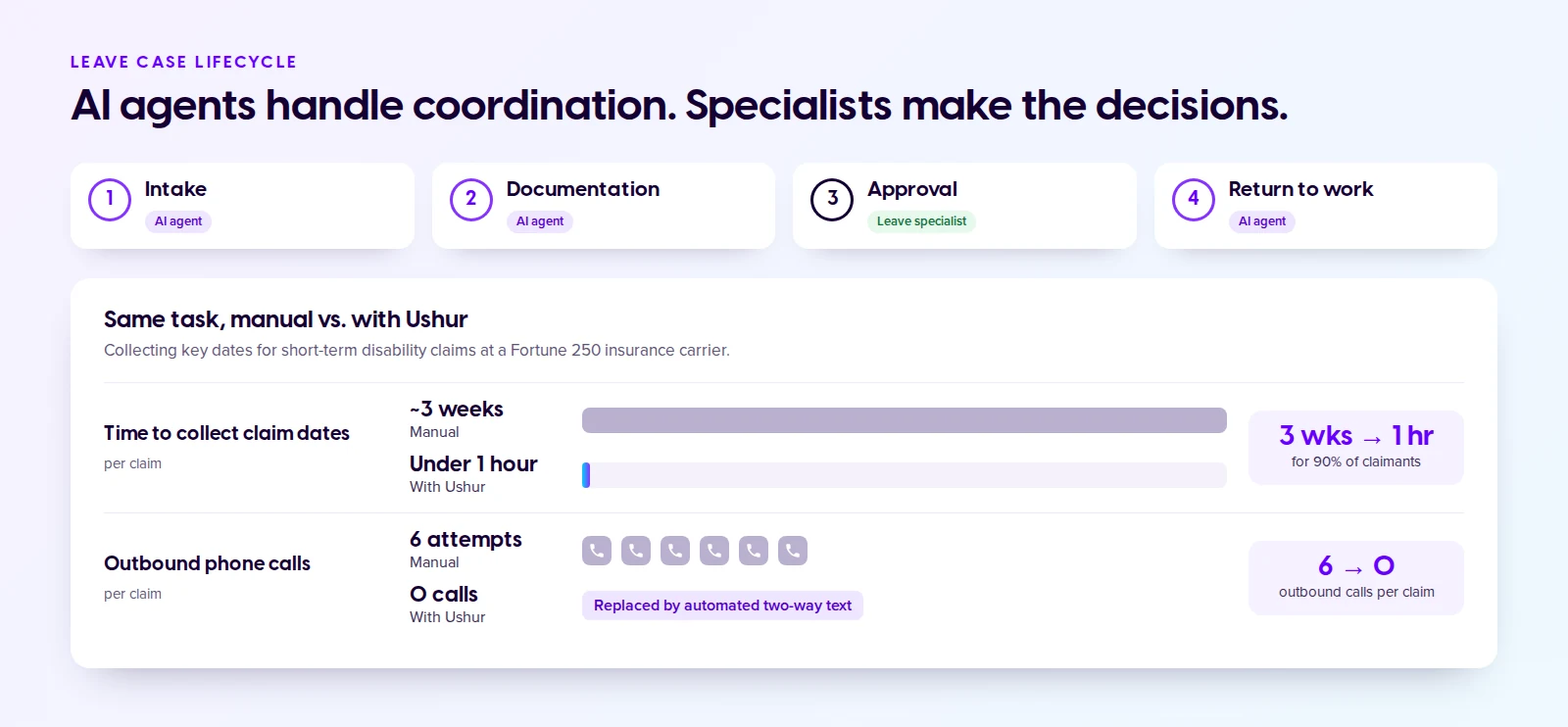
- Manual intake is where the time goes. At a Fortune 250 insurance carrier, collecting key short-term disability claim dates took six phone attempts and about three weeks per claim. With Ushur's automated two-way text, 90% of claimants respond in under an hour.
- AI agents don't replace leave administrators' judgment on eligibility. They remove the manual chasing: intake, form completion, employer/HR coordination, and status communication that consumes most of that time.
- Ushur's AI agents guide employees and employers through leave-of-absence intake, documentation, and status updates within a Trust-Native, compliant framework built for regulated employers, carriers, and their TPAs.
Leave Administration Is a Compliance Risk Hiding Inside an Operational One
Leave of absence management, spanning FMLA, state paid family and medical leave (PFML), ADA accommodation, and short-term disability, sits at the intersection of employee experience and legal exposure. Get it wrong operationally (a missed deadline, an incomplete form, a case that falls through the cracks between HR and a manager) and the operational failure becomes a compliance failure. The employee experience is on the line too: Guardian's 2025 research found that employees who have a positive leave experience are 75% more likely to stay with their employer for five or more years.
The scale problem is real too. In the U.S. Department of Labor's 2018 FMLA surveys, 15% of employees reported taking leave for a qualifying FMLA reason in a single year. Every one of those cases runs through intake, form completion, tracking, and closeout, and when that work is coordinated by hand, HR time goes to administrative chasing rather than the judgment calls leave administration actually requires. Mercer found that 40% of employers have difficulty managing intermittent leave, and the same share struggle with statutory leaves.
Multi-state employers face a compounding version of this problem. With 14 states and the District of Columbia running their own mandatory paid family leave programs, each with different eligibility, notice, and documentation rules, a leave team has to track every jurisdiction its employees work in. The result is cases that take weeks to move through a process that, done well, should take days.
Where Manual Process Breaks Down, and Where It Doesn't Need To
Most leave-administration failure points aren't judgment failures. They're coordination failures. An employee doesn't know which form applies to their state. A manager forgets to submit documentation on time. A case sits in an inbox because no one owns the next step. None of that requires a human decision about eligibility; it requires someone (or something) making sure the process actually moves.
This Is the Exact Shape of Problem Conversational AI Agents Are Built to Solve
- Guided intake that asks an employee the right questions for their state and leave type, and routes them to the correct form automatically, rather than a static PDF and a guess
- Proactive document collection with reminders that go out before a deadline, not after one's missed
- Real-time status visibility for both the employee and their manager, cutting down the "where's my leave request" calls that consume HR time
- Automated coordination between the employee, HR, and payroll so a leave case doesn't stall in the handoff between systems or people
- Escalation to a human leave specialist, with full case context, the moment a request involves a genuine eligibility or accommodation judgment call
Why Audit Readiness Is So Hard to Guarantee
The compliance numbers are worth sitting with. In Mercer's 2024 survey, 72% of employers said they have had to add resources to stay compliant with leave mandates, and 55% named training their teams on absence management as their biggest challenge. Training matters, but it can't fix a systems problem. When leave tracking lives across spreadsheets, email threads, and individual HR staff members' memory of "how we usually handle this," consistent, auditable documentation is nearly impossible to guarantee at scale.
An AI agent that handles intake and documentation collection produces a byproduct that manual process can't: a consistent, timestamped, auditable record of every interaction, for every case, in every state, which is what actually holds up in an audit or an employee dispute, independent of how well any individual staff member remembers a specific case.
Governance and Compliance Built for Regulated Employers
Leave-of-absence data includes protected health information, disability status, and other sensitive employee data, so governance has to be foundational, not bolted on.
An AI Platform Operating in This Space Needs
- Trust-Native architecture with role-based access controls so only the right people ever see medical documentation tied to a leave case
- Full audit trails across every interaction, closing the documentation gap described above
- HIPAA-compliant, encrypted handling of medical certifications and disability documentation
- State-aware workflow logic that keeps a multi-state employer's leave process compliant without manual tracking of every jurisdiction's rules
- Human escalation with full context for every eligibility or accommodation decision that requires a specialist's judgment
Where Ushur Fits: AI Agents for Leave of Absence Management
Ushur helps employers, carriers, and their leave-administration TPAs automate the intake, documentation, and communication layer of FMLA, PFML, ADA, and disability leave cases. Employers are ready for it: Guardian found that 65% of employers are considering AI for their absence management programs, and 19% have already implemented it.
The results are already measurable. A Fortune 250 insurance carrier uses Ushur's Invisible App to automate claimant interactions in its short-term disability claims process, sending more than 70,000 text messages a month to 25,000 claimants to collect return-to-work, surgery, and maternity dates. Engagement runs near 85%, half of claimants respond within five minutes, and 90% within an hour, replacing an average of six outbound calls and three weeks per claim. Read the customer story.
For HR and Benefits Teams, Ushur Delivers
- Guided, state-aware intake that routes employees to the right forms and requirements automatically
- Proactive, omnichannel document collection across SMS, email, and web, reducing the manual chasing that eats HR hours
- Real-time case status for employees, managers, and HR without added inbound call volume
- Trust-Native governance with the audit trails and access controls a leave case's sensitive data requires
- No-code deployment that lets HR and benefits teams launch a new leave workflow without a lengthy implementation project
Learn more about Ushur's leave and absence engagement solution, or request a demo.
Conclusion
Leave-of-absence management fails employees and employers in the same place, over and over: not in the eligibility decision, but in the coordination around it. The missed form, the stalled handoff, the case nobody's tracking closely enough. AI agents that take on that coordination give HR and benefits teams back the hours currently spent chasing process, and give employees the thing they actually need during a leave: a process that visibly moves, instead of one they have to keep calling about.
Frequently Asked Questions About AI and Leave of Absence Management
Does AI decide whether an employee is eligible for leave?
No. Eligibility and accommodation decisions should stay with trained leave specialists. AI agents handle the intake, documentation collection, and status communication around the decision, not the decision itself.
How much time can automation save in leave administration?
At a Fortune 250 insurance carrier using Ushur, collecting key short-term disability claim dates dropped from about three weeks and six phone attempts per claim to under an hour for 90% of claimants, using automated two-way text.
Why is multi-state leave compliance so difficult to manage manually?
Fourteen states and the District of Columbia have enacted mandatory paid family leave programs, each with different rules, according to the Bipartisan Policy Center. In Mercer's 2024 survey, 68% of employers ranked compliance with state and local leave mandates among their top three priorities.
How does automation improve leave-related audit readiness?
By producing a consistent, timestamped, auditable record of every intake and communication step for every case, replacing the inconsistent documentation that comes from spreadsheets and individual staff memory.
Sources
- Mercer: 2024 Absence and Disability Management Survey (630 U.S. employers)
- Guardian: The Employee Leave Experience, 2025 (1,215 employers, 2,000 employees)
- U.S. Department of Labor: Employee and Worksite Perspectives of the FMLA, 2018 Surveys
- Bipartisan Policy Center: State Paid Family Leave Laws Across the U.S.
- Ushur: Transforming claimant engagement (Fortune 250 insurance carrier)