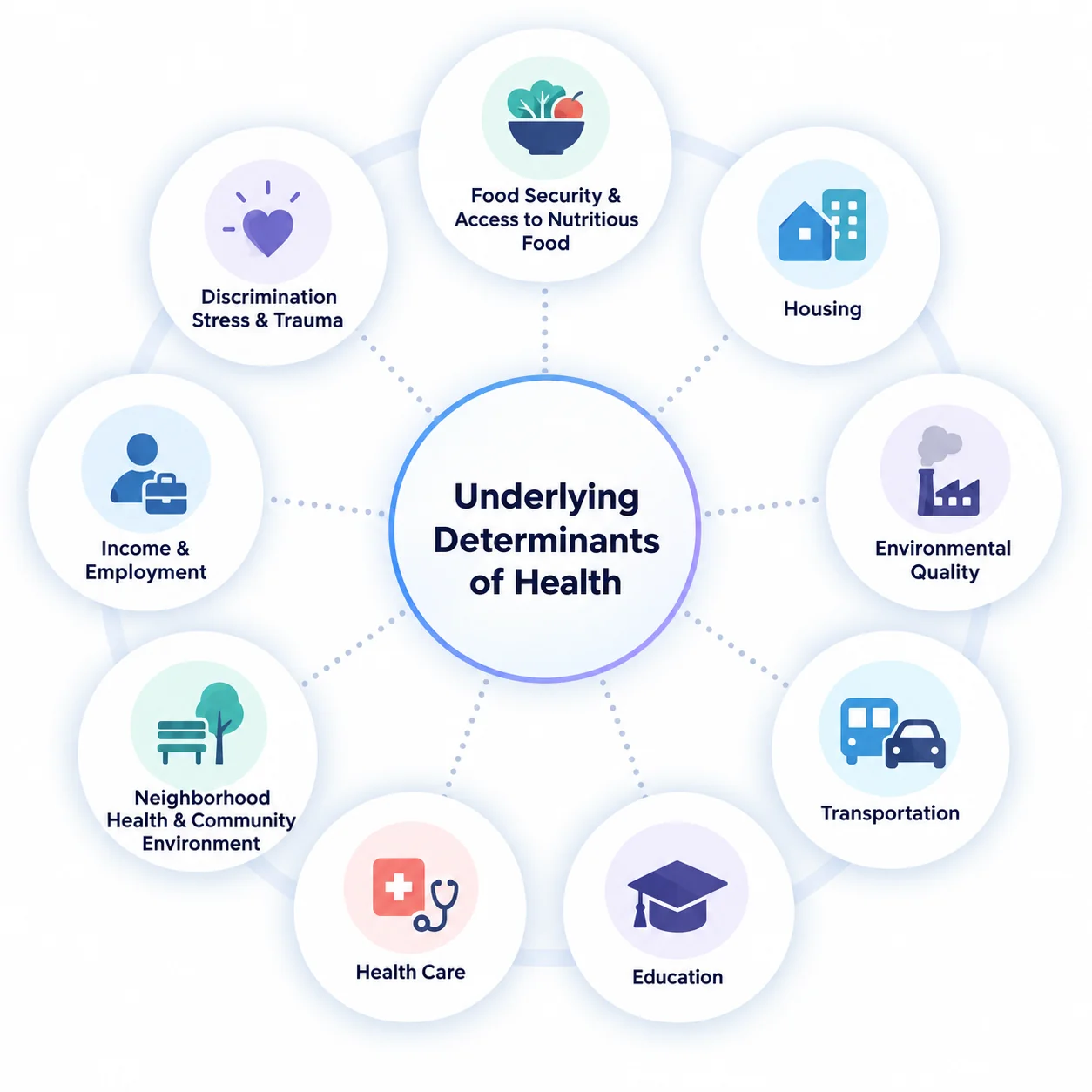
Healthcare organizations need to know their members’ and patients’ social determinants of health (SDOH) status, or that knowledge gap becomes a barrier that blocks care delivery and worsens outcomes. SDOH are the environmental factors that determine whether someone can actually act on medical guidance: housing stability, nutrition, income, transportation, and community connectivity. A care plan that assumes reliable transportation to a pharmacy, or consistent access to specific foods, fails the moment those assumptions are wrong. Most health plans have no systematic way to know when they are.
Picture a diabetic patient whose care team doesn’t know what food is actually available to them. A static chronic care plan built without that knowledge is set up to fail. Now picture that same patient responding to a message on their smartphone through Ushur’s Invisible App, a user-friendly and HIPAA-compliant digital channel for information exchange and two-way communication. The user simply answers a short, adaptive survey that not only securely gathers the information the health plan needs, but immediately connects them to a nearby food resource or transportation to their next appointment.
Better Data = Better Healthcare Delivery
What kind of data does a healthcare provider or payer need from members and patients to understand SDOH? Environmental factors matter most: housing security, food security, income stability, social connectivity, and transportation access all provide meaningful signal about likely health outcomes.
Healthcare questions related to SDOH need to go beyond the basics, which is why automated surveys are such an effective tool. They can be delivered quickly and easily across a broad population, and because respondents may need to complete it on their own time, it’s important that surveys be offered via any device. When offered digitally, immediately after the survey respondents can also be served SDOH support resources near the patient or member in real time based on their answers. That’s much harder to do with static surveys or even live interactions.
With Ushur, health plans and providers can reach patients and members with HIPAA-compliant SDOH surveys designed to gather important SDOH information, reduce the propensity for survey abandonment, and direct members and patients to relevant help.
Four Key Benefits of Ushur for Gathering Patient Data
Stay HIPAA Compliant
With HIPAA requirements and privacy concerns, you need a tool that has built-in safety mechanisms, versus other communication tools like SMS messaging or print. Ushur’s HIPAA-secure Invisible App is designed to meet those requirements, with end-to-end encryption, and no need to download or log in to a portal or app. Learn more about Ushur’s security and compliance posture.
Be Patient Comfort-Centric
It’s common now for payers and providers to ask questions, either live or via a form, about SDOH like food availability, physical safety, and even housing. But that doesn’t mean members and patients feel comfortable answering those questions live with someone they’ve never met, and that unease only grows when the questions are asked in person. Ushur’s Invisible App works on any device, including smartphones or computers, which means the patient can answer when they want to, where they want to. Healthcare companies can set up experiences to support any of 74+ languages to be sure members and patients can use their preferred language. And as part of Ushur’s omnichannel self-service support, patients don’t have to start over if they switch from their phone to their laptop, for example.
Remain Brief but Relevant
With static surveys that are mailed or delivered via a portal, all of the questions are presented at once without the ability to omit questions that aren’t relevant to a portion of the audience (for example, questions related to women’s health going out to male respondents). Healthcare companies also lose the ability to dig deeper into a topic based on the way a question is answered. Ushur allows surveys to be tailored for audience relevance, and also allows additional questions to be served up based on prior survey answers. For example, if you’re asking about housing safety and security, and a respondent flags an issue in that area, you can present additional questions to better understand their situation and the type of support they need.
Deploy Fast, Without Engineering Overhead
Ushur enables healthcare companies to deploy an app-like SDOH survey experience without pulling IT or engineering resources onto the project, saving time and resources and drastically increasing speed to value. Ushur integrates with existing front- and back-end systems, passing data to and from core systems seamlessly in the background. That means it can link securely to patient data in electronic health record (EHR) and CRM systems for more accurate information and less data entry on the member or patient’s part. Healthcare companies can customize the survey to meet the needs of their specific patient segments, eliminating questions that aren’t relevant to a given audience to reduce the overall question count.
Going Beyond Collecting Data to Offering Help and Support
Many of us are familiar with apps that make recommendations based on what they already know about us and our shopping behavior. What if a healthcare survey could do something similar? For example, if a member indicates they don’t have food to feed their family right now, what if the app could provide a list of nearby food banks or meal-delivery contact information to help them get immediate help? That’s a win-win: the healthcare company now knows a key SDOH factor, and the member or patient gets immediate help. What if the tool could take it a step further by pushing an alert to providers or clinical resources for follow-up where there are medical or behavioral health concerns?
That’s exactly what Ushur’s AI agents can do. The social determinants of health survey is an example of how Ushur helps health payers and providers get closer to their members. Because Ushur workflows are fully customizable, each healthcare client decides how automation can best serve and improve the member experience. The possibilities are almost endless.
The Bottom Line: Information + Action = Better Care
From a business perspective, better understanding SDOH is common sense. A healthier population requires fewer costly services, which lowers overall healthcare costs in the long run.
Beyond business, healthcare is about health. The more healthcare companies can understand a 360-degree view of a person, the better they can deliver the care and support services people need to live longer, healthier lives.
Conclusion
Ushur’s AI agents and Invisible App are already helping Fortune 500 and Global 1,000 companies redefine the strategies they use to optimize their customer experience and get closer to their consumers. Social determinants of health are just one example of how Ushur engages business users to build state-of-the-art, AI-driven customer experiences.
Ready to see how Ushur can improve your SDOH outreach? Learn more at ushur.ai/request-demo.
Frequently Asked Questions About Social Determinants of Health
What are social determinants of health (SDOH)?
SDOH are the non-medical factors, such as housing, food security, income, transportation, and social connectivity, that significantly affect a person’s health outcomes and their ability to act on medical guidance.
Why do health plans need SDOH data?
Without SDOH data, a care plan risks being built on false assumptions, recommending steps a member can’t actually take due to unaddressed barriers like transportation or food access. That limits the plan’s real-world effectiveness.
How does the Invisible App improve SDOH survey completion?
By adapting the survey conversationally and in real time, skipping irrelevant questions, and running on the channel and language the respondent prefers, rather than presenting a static, one-size-fits-all form.
Can SDOH outreach connect members to resources immediately?
Yes. The Invisible App can surface relevant support resources, such as nearby food banks or transportation options, in the same conversation where a member discloses the need, rather than as a delayed follow-up.